

The end of summer often brings a desire for a fresh start. We return to our daily routines, yoga studios open new classes, and perhaps you have been thinking for a while: “This year, I’m finally going to start yoga.”
But if you have never been to a yoga class before, questions quickly arise. Which style of yoga should I choose? Do I need to be flexible? What should I wear? Will I be able to keep up with the others? And what are all those blocks, yoga belts, blankets, bolsters and chairs I see in a yoga studio?
There is one important thing to know before you begin: you don’t need to be flexible, strong or familiar with yoga poses to start. You don’t come to yoga because your body can already do certain things. You come to yoga to begin understanding your body better.
In Iyengar Yoga, poses are learned gradually, with precise instructions, careful observation of the body and, when needed, the support of yoga props. Props are not there to do the pose for you. They help you find stability, understand the direction of movement and adapt the pose to your body.
If you are thinking about attending your first class, we have put together a practical guide. We will look at what Iyengar Yoga is, what happens in your first class, what you need to get started and why props play such an important role in this method. Most importantly, we will answer some of the questions beginners often have before they step onto a yoga mat for the first time.
What is Iyengar Yoga?
Iyengar Yoga is a method of yoga developed by B. K. S. Iyengar, one of the most influential yoga teachers of the 20th century. It is based on the precise practice of yoga poses, attention to alignment, carefully considered sequencing of asanas and gradual progression through practice.
In class, the aim is not simply to get into a particular pose. What matters is how you enter it, how you work within it and what is happening in your body while you are there. The teacher demonstrates the pose, gives clear instructions and guides your awareness towards the actions of different parts of the body. With regular practice, you develop not only flexibility but also stability, strength, balance, body awareness and concentration.
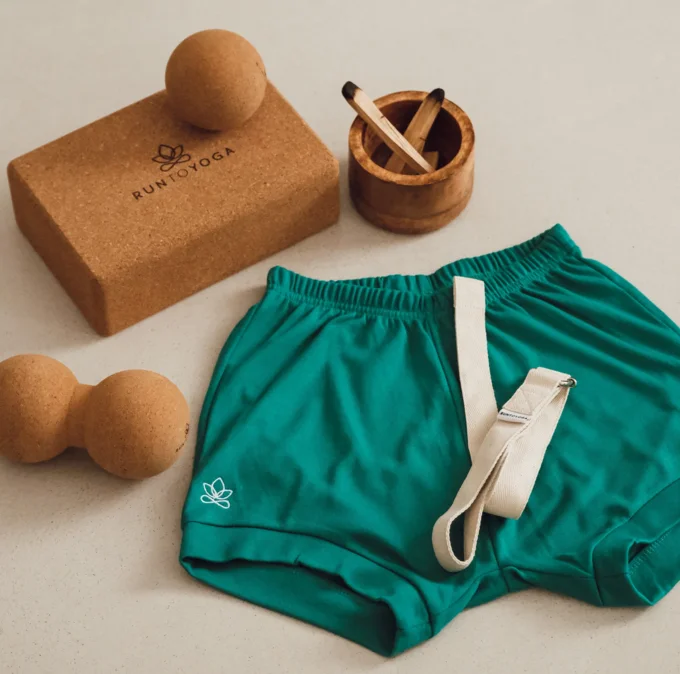
One of the most recognisable features of Iyengar Yoga is the use of yoga props. Yoga blocks, yoga belts, blankets, bolsters, chairs and other props allow us to explore a pose according to our body's current abilities and needs. Sometimes a prop brings the floor closer, at other times it supports better alignment or helps us stay in a pose longer so that we can observe it more precisely.
This approach makes Iyengar Yoga accessible even to people with no previous yoga experience. You do not need to force your body to fit the pose. A good teacher finds a way to adapt the pose to the body in front of them that day.
If you would like to learn more about B. K. S. Iyengar, his life, the development of his method and the origins of yoga props, you can read more here.
Is Iyengar Yoga suitable for beginners?
“I’m not flexible enough for yoga.” This is one of the most common concerns before a first class. But flexibility is not a requirement for starting. Iyengar Yoga is particularly suitable for beginners because poses are learned gradually, with clear instructions and careful attention to correct alignment.
It does not matter how far you can reach or whether you can do the same thing as the person on the yoga mat next to you. What matters more is how you work in the pose and what you learn about your body along the way.
This is also where yoga props can help. A yoga block can bring the floor closer, a yoga belt can extend your reach, while a blanket or bolster can provide the support your body needs. In this way, poses can be adapted to different bodies and abilities.
For your first class, you do not need previous experience, exceptional flexibility or excellent fitness. You simply need to be willing to begin.
What happens in your first Iyengar Yoga class?
If you are coming to an Iyengar Yoga class for the first time, arrive a few minutes early and tell your teacher about any injuries, pain or other limitations that could affect your practice.
The class usually begins in the seated pose Svastikasana. If sitting on the floor is difficult, you can sit on folded foam, a blanket or a bolster. This provides a more stable base and makes it easier to maintain an upright, well-aligned spine. At the beginning of the class, we chant Om three times. In some Iyengar Yoga schools, this is followed by the Invocation to Patanjali, which traditionally marks the beginning of the practice.
The teacher then gradually guides the group through selected asanas. The pose is first demonstrated and explained, and then you practise it yourself. You will receive clear instructions, and you may repeat a pose several times, discovering something new with each attempt.
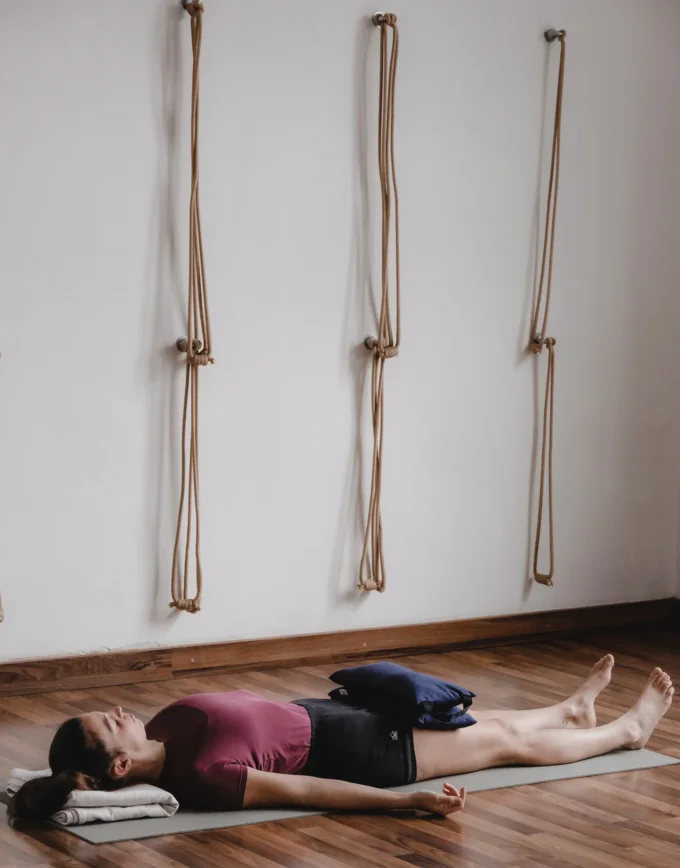
The class usually ends with Savasana, the relaxation pose, allowing the body to settle after the practice.
How is an Iyengar Yoga class structured?
An Iyengar Yoga class usually lasts around 90 minutes, but that does not mean you will spend the entire time simply moving from one pose to the next. An important part of the method is the sequencing of asanas. Poses are carefully selected and arranged so that each asana prepares the body for what follows.
Classes often have a particular focus. One class may concentrate more on standing poses, while another may explore seated poses and forward bends, twists, or backbends. Over time, inversions such as Salamba Sarvangasana (Shoulderstand) and Salamba Sirsasana (Headstand) are gradually introduced.
And if Sirsasana seems completely impossible during your first class, don’t worry. In Iyengar Yoga, you do not learn to stand on your head overnight. First, you learn the actions needed for the pose, develop stability in the shoulders and arms, and become familiar with preparatory poses. When you are ready, your teacher will guide you into the pose gradually and safely, using the wall and yoga props when needed.
This is one of the distinctive aspects of Iyengar Yoga: you learn not only individual poses, but also how they relate to one another and how thoughtful sequencing can change the effect of the entire practice.
Why do we use so many props in Iyengar Yoga?
When you first walk into an Iyengar Yoga studio, you may be surprised by the number of props: yoga blocks, belts, blankets, bolsters, foam pads, chairs and ropes. Their purpose is not to do the poses for us or simply to make the practice easier.
A prop helps us practise a pose more precisely and adapt it to our body. If your hand does not reach the floor in Trikonasana, you can support it on a yoga block and maintain better alignment. A yoga belt can extend your reach, a blanket or foam pad can provide the necessary height, while a bolster supports the body in poses where we want to stay for longer.
B. K. S. Iyengar developed the use of props over many decades to make the practice accessible to different bodies, ages and abilities. Importantly, props are not only for beginners. They can also help experienced practitioners explore a pose with greater precision, depth and a fresh perspective.
Which props will you use most often?
You do not need a room full of yoga props to get started. A few essentials, however, are used in almost every Iyengar Yoga class:
- A yoga mat is the foundation of your practice. A stable, non-slip surface provides good grip and helps with the correct placement of the feet and hands.
- Yoga blocks bring the floor closer and provide support where you need it. They are used in standing poses, seated poses and many other asanas, so it is useful to have two.
- A yoga belt acts as an extension of your arms. It helps when you cannot yet reach your feet or another part of the body, and can also help maintain the correct distance and direction in a pose.
- Blankets and foam pads provide height and support and help position the body appropriately.
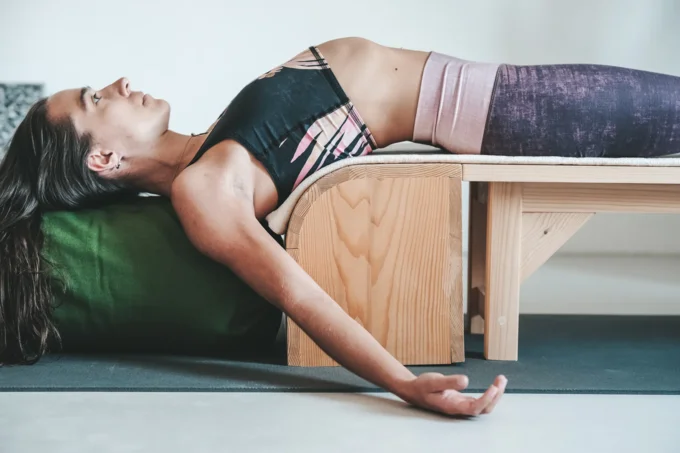
- A bolster provides greater, more stable support and is often used in supported poses, pranayama and restorative practice.
With these basic props, you already have an excellent foundation for developing your Iyengar Yoga practice at home.
What about injuries, pain or menstruation?
Lower back pain, a sensitive neck, knee problems or an old injury do not necessarily mean that yoga is not for you. What matters is that you tell your teacher about any problems before the class begins. This allows the teacher to adapt certain poses, add extra support or offer you a different variation of an asana. This is also where props become particularly valuable, allowing the practice to be adapted to the body, rather than the other way around.
If you have a more serious injury, acute pain, a herniated disc or are recovering from surgery, consult your doctor and your yoga teacher before beginning practice. A regular group class may not always be the most appropriate option, and in some cases an individual session or a therapeutically oriented Iyengar Yoga class may be more suitable.
What if I’m menstruating?
Having your period does not automatically mean you need to skip your yoga class. Let your teacher know that you are menstruating, as the practice in Iyengar Yoga is adapted during this time. Instead of more intense poses and inversions, you may be given a quieter, more supported practice with seated poses, forward extensions and Supta poses.
If you have had a demanding day or simply feel tired, this kind of practice can be especially welcome. Bolsters, blankets, chairs and other supports allow the body to feel supported within the poses. The aim on such a day is not to do as much as possible, but to listen to your body and adapt the practice to what it needs.
What should you wear to an Iyengar Yoga class?
You do not need special yoga clothing for your first class. The most important thing is to wear clothes that are comfortable, breathable and fitted enough to allow you to move freely while enabling your teacher to clearly see the alignment of your body. A cotton T-shirt with leggings or shorts is a good choice. Yoga is practised barefoot.
If you continue practising Iyengar Yoga, you will soon notice the distinctive shorts worn by many teachers and practitioners. Their design is no coincidence. Because precise alignment is an important part of the method, the teacher needs to be able to clearly see the position of the knees and thighs and the alignment of the legs in order to guide you correctly.
If you are curious about why these shorts have become such a characteristic part of Iyengar Yoga, you can read more about their history and use here.
When yoga comes home with you
When you start practising Iyengar Yoga, something unexpected can quickly happen: after a few classes, you may find yourself wanting to practise at home too. Suddenly, a yoga mat in the corner of your living room will no longer look out of place, and two yoga blocks and a yoga belt may find a permanent home there as well.
For your home practice, you do not need all the equipment you see in a yoga studio. A few basic, good-quality props are enough to begin. They allow you to repeat the poses you have learned with your teacher and gradually develop your practice between classes.
To save you from having to choose every prop separately, at RunToYoga we have created yoga prop sets that bring together the basic equipment for different types of practice. You can choose a set that suits your practice and add to it later as your needs develop.
Explore RunToYoga yoga prop sets
