


Between 10 and 13 October 2026, I attended the sixth module of the Seeing & Understanding from the Base educational programme in Budapest, led by renowned Iyengar Yoga teacher Stephanie Quirk. This module, titled Acquiring the State of Balance & Harmony, Systemic Imbalance, focused on exploring balance, the interconnectedness of the body's systems and the therapeutic approach in Iyengar Yoga.
Stephanie Quirk is an internationally recognised Iyengar Yoga teacher, particularly known for her extensive knowledge of therapeutic applications of yoga. She lived and worked in Pune, India, for more than 20 years, studying directly with the Iyengar family at the Ramamani Iyengar Memorial Yoga Institute (RIMYI) and assisting in therapeutic yoga classes. Today, she shares her wealth of experience with teachers and experienced practitioners around the world.
The central theme of the four-day workshop was adapting yoga practice to different health conditions, from high and low blood pressure to chronic fatigue and neurological disorders. Through lectures and practical demonstrations, Stephanie showed how important it is to understand each individual's health condition, abilities and limitations, and to use this understanding to develop an appropriate sequence of asanas.
We paid particular attention to precision in practice, sequencing and the thoughtful use of props. We explored how changes in support, the direction of extension or the duration of a pose can influence the experience of practice. These details are essential to understanding the therapeutic approach in Iyengar Yoga, where choosing an asana is only one part of a broader, carefully considered process.
Day one: From blood pressure to a practice supporting the immune system
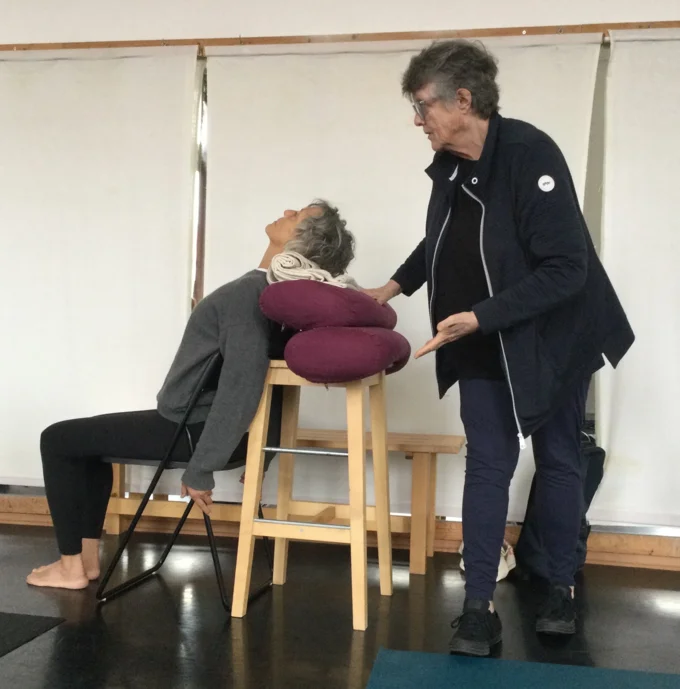
On the first day, we focused on high and low blood pressure, exploring how the selection and adaptation of asanas can help us develop a practice suited to people with different health conditions.
During the morning lecture, Stephanie shared a story from India dating back to 2009, when the city of Pune was facing an outbreak of H1N1 influenza.
During this period, B. K. S. Iyengar developed a special sequence of asanas intended to support the immune system. Stephanie explained the circumstances in which the sequence was created and how Iyengar approached the health challenges of that time through his selection and sequencing of poses.
The story was particularly interesting because of the parallels with the COVID-19 pandemic that we experienced more than a decade later.
We dedicated our morning practice to this very sequence, which Stephanie introduced under the title Practice That Supports the Immune System.
We practised Adho Mukha Svanasana, Uttanasana, Prasarita Padottanasana, Sirsasana, Dwi Pada Viparita Dandasana, Sarvangasana and Halasana. Some poses had to be adapted because we did not have all the props required for the original sequence, including wall ropes for Sirsasana and specific chair arrangements for supported inversions.
The sequence combines forward bends, supported backbends and inverted poses. Particular attention is given to appropriate support for the body, the position of the head and creating conditions that allow the asanas to be held steadily for longer periods without unnecessary effort.
Afternoon practice: Support, breath and balance
In the afternoon, we continued exploring low blood pressure and how to adapt the practice to individual needs. Stephanie also discussed orthostatic hypotension, a condition in which standing up quickly from a seated or lying position can cause dizziness due to a sudden drop in blood pressure.
We paid particular attention to opening the chest and positioning the shoulders, pelvis and head. Using bolsters, blankets, blocks and chairs, we explored different supported poses, particularly Savasana and Supta Virasana.
During the practical demonstrations, we observed how even a small adjustment in the height of a support can influence the position of the spine, the distribution of weight and the experience of an asana. Stephanie emphasised the importance of creating space in the chest and providing appropriate support that allows the body to relax without losing proper alignment.
We also explored the concept of prana vayu, which in yogic philosophy is associated with inhalation, receiving and vital energy. Our attention turned to observing the breath, particularly the brief, almost imperceptible pause between inhalation and exhalation.
Towards the end of the day, we reflected on the broader meaning of yoga practice. Why do people keep returning to yoga? Often, it is simply because they feel better after practising. Yet regular practice also offers an opportunity to develop greater awareness, recognise habitual patterns and gradually change the way we relate to ourselves and others.
In teaching, therefore, it is not only the correct execution of an asana that matters, but also understanding the person practising it. Every student comes with different needs, abilities and limitations. The teacher's responsibility is to recognise these differences and adapt the practice accordingly.
Day two: High blood pressure, chronic fatigue and adapting the practice
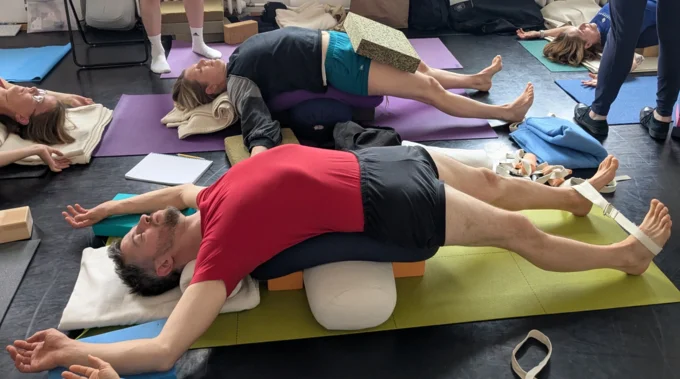
On the second day, we explored high blood pressure, chronic fatigue and health issues following COVID-19 in greater depth. We examined how to adapt yoga practice to an individual's health condition, limitations and physical response to different asanas.
Stephanie described high blood pressure as the silent killer, as it can remain without noticeable symptoms for a long time. Our discussion also touched on various complaints, such as a feeling of pressure in the head and burning eyes, as well as connections with other health conditions, including diabetes.
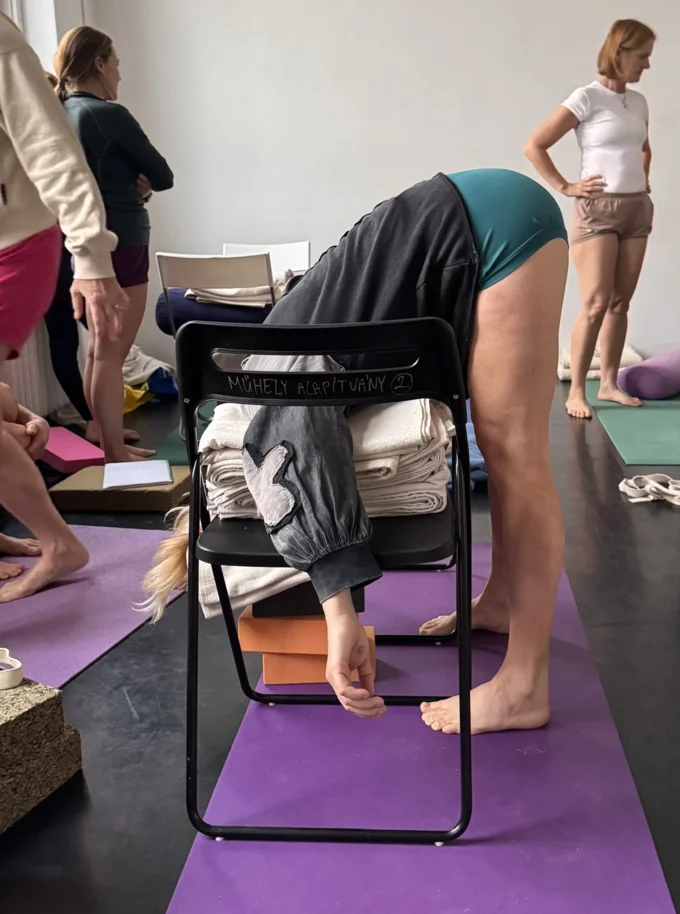
In the practical session, we began with standing forward bends, focusing on appropriate support for the head and the position of the eyes. We explored how the direction of the gaze, the position of the neck and the height of the support affect the feeling of tension, and how to create conditions for holding a pose more calmly and steadily.
We continued with supported asanas such as Supta Virasana, Supta Baddha Konasana, Salamba Purvottanasana and Ustrasana. Using bolsters, blankets, blocks and chairs, we experimented with different ways of supporting the body. Particular attention was given to the position of the chest, shoulders and spine, and to reducing unnecessary muscular effort.
An important part of the day was also dedicated to chronic fatigue and post-COVID health issues. Stephanie emphasised that, in such conditions, holding asanas for longer periods or practising more intensely may not be appropriate. The key is to observe the individual's response, recognise signs of overexertion and adjust the duration and intensity of the poses accordingly. We also discussed changes in lip colour as a possible warning sign.
We explored a sequence that included Adho Mukha Virasana, Supta Virasana, Adho Mukha Svanasana, Salamba Purvottanasana and Uttanasana. Some variations required several props and assistance from other participants to position the supports for the head, neck and torso precisely.
The practical demonstrations clearly illustrated the importance of the relationship between the selection of asanas, their sequence, duration and method of execution. With different support or modifications, the same pose can require considerably less effort and offer a different experience of practice. The ability to observe these differences and understand an individual's response is one of the essential foundations of the therapeutic approach in Iyengar Yoga.
Days three and four: Neurological conditions and therapeutic practice
During the final two days, we focused on neurological and other chronic conditions, including Parkinson's disease. We discussed how difficulties with balance, coordination, muscular strength and mobility can affect everyday movement, and how yoga practice can be adapted accordingly.
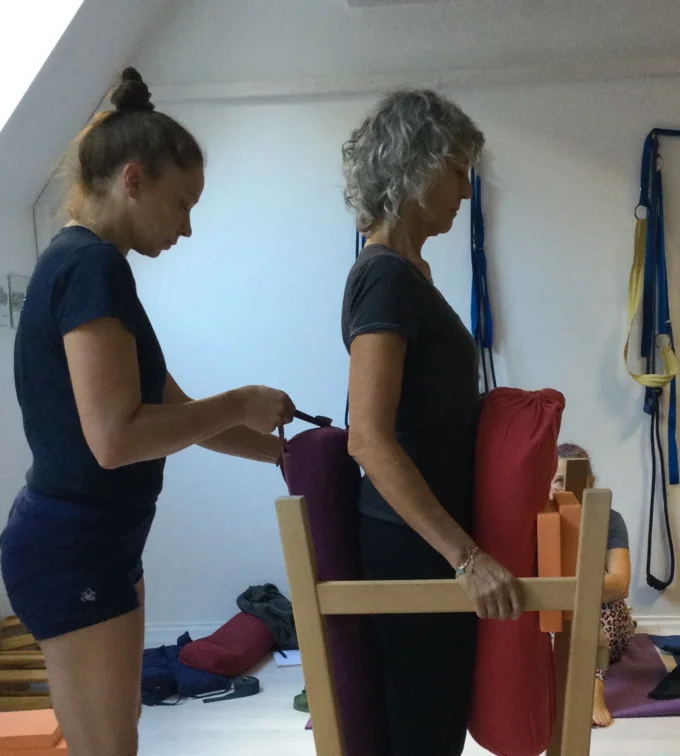
Much of our time was devoted to practical work. We moved to a well-equipped yoga studio with a wide range of props, including wall ropes, a yoga horse, chairs, belts, bolsters and wooden blocks. This allowed us to explore different variations of standing poses, forward bends, backbends and inversions.
Through demonstrations, Stephanie showed how the thoughtful use of props can provide appropriate support and make poses accessible to people with limited mobility or reduced balance. We explored stability, spatial awareness and the positioning of the pelvis, spine and shoulder girdle. It was particularly instructive to observe how even a small change in body position or the height of a support could influence the execution of an asana.
We also experimented with different ways of using wall ropes and the yoga horse, which offer alternative approaches to extending the spine, opening the chest and practising supported inversions. Throughout these sessions, Stephanie continually emphasised the importance of careful observation and understanding why a particular modification is used.
One of the most important messages of the final two days was that the same diagnosis does not necessarily call for the same yoga practice. When designing a sequence, we must consider each person's age, health condition, physical abilities and current limitations. The practical demonstrations showed just how varied and individually tailored the therapeutic approach in Iyengar Yoga can be.
Four days with Stephanie Quirk offered a wealth of new insights, practical experience and opportunities for deeper exploration. The workshop once again demonstrated the depth of knowledge and understanding of the body required for the therapeutic approach in Iyengar Yoga.
What I particularly appreciate about Stephanie is her ability to connect complex subjects with practical examples. Her explanations, precise demonstrations and thought-provoking questions encourage us to look beyond simply performing an asana and seek to understand how it works and what its purpose is.
Good teaching requires continuous observation, exploration and a willingness to learn. Every workshop like this raises new questions and offers a fresh perspective on a practice we have known for many years.
I look forward to continuing this learning journey and discovering what the seventh module will bring.