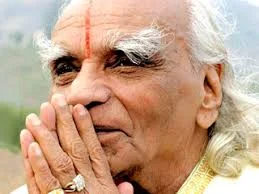


“Yoga is a light, which once lit will never dim. The better your practice, the brighter the flame.”
B. K. S. Iyengar
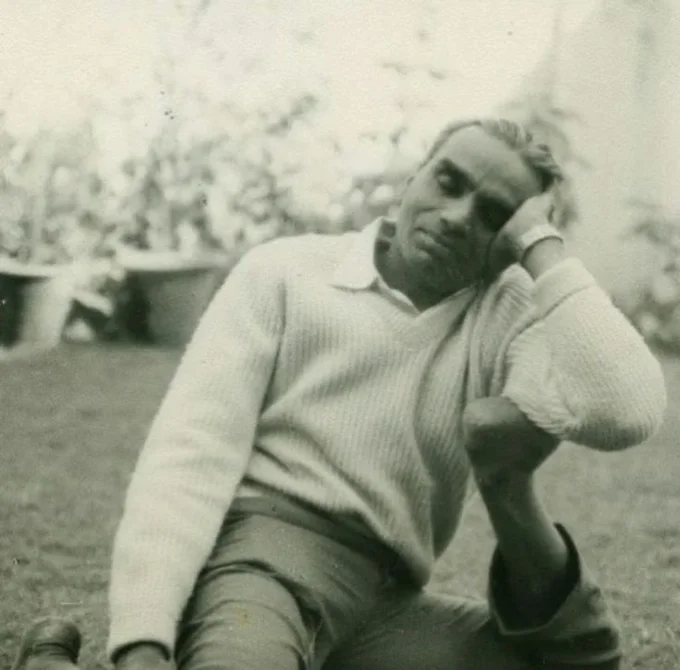
Every year on 14 December, the Iyengar community around the world pauses to mark the birthday of a teacher whose influence reaches far beyond the yoga mat. Bellur Krishnamachar Sundararaja Iyengar (1918–2014) did not merely create one of the most widely practiced forms of modern yoga. He developed a method for exploring the human body, breath, mind, and ethics, a method that continues to shape how yoga is taught, understood, and lived today.
His legacy is not preserved only in books or certification systems, but in every precisely placed asana, in each moment of focused attention, and in every practitioner who continues even when practice is not easy.
From fragile beginnings to a path of inquiry
Iyengar was born in 1918 in Bellur, India, at a time marked by scarcity and social constraints. His childhood was shaped by illness. Malaria, typhoid, and tuberculosis left his body weak and his health uncertain. As a child, he showed no signs of becoming a future “yoga master.” Quite the opposite.
Yoga was not initially a choice, but a necessity. As a teenager, he was sent to his brother-in-law and guru, T. Krishnamacharya, to strengthen the body through practice. The beginning was not easy. It was demanding, strict, and often painful. Yet this experience forged a fundamental quality that stayed with Iyengar throughout his life: perseverance.
His starting point was not an ideal body, but a real body with limitations. And precisely for this reason, his yoga later became yoga for real people.
Every day on the mat, without exception
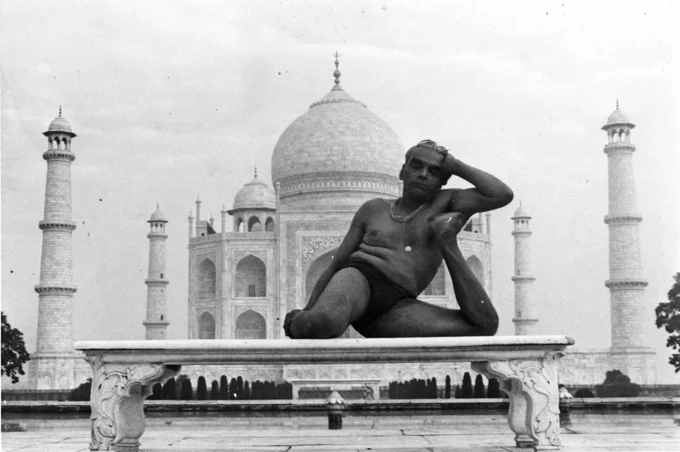
Iyengar often emphasized that his authority did not arise from talent or charisma, but from daily practice. He practiced every single day. Not occasionally, not seasonally, but consistently. Even in his later years, when he was already regarded as a global authority, he continued to practice for several hours a day.
His practice was not a repetition of the familiar. It was an inquiry.
He practiced asanas for decades, seemingly the same, yet never the same in experience. Each day, he examined anew:
- alignment,
- direction of movement,
- the function of the feet, legs, and spine,
- the effect on the breath,
- the impact on the mind.
Practice was his laboratory, a place where the body asked questions and yoga offered answers.
Practice as a personal dialogue with the body
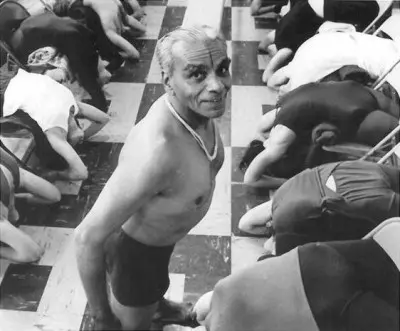
Iyengar did not believe in universal formulas. His own practice changed over the decades. After injuries, through pain, and as the body aged, he did not abandon practice. Instead, he reshaped it.
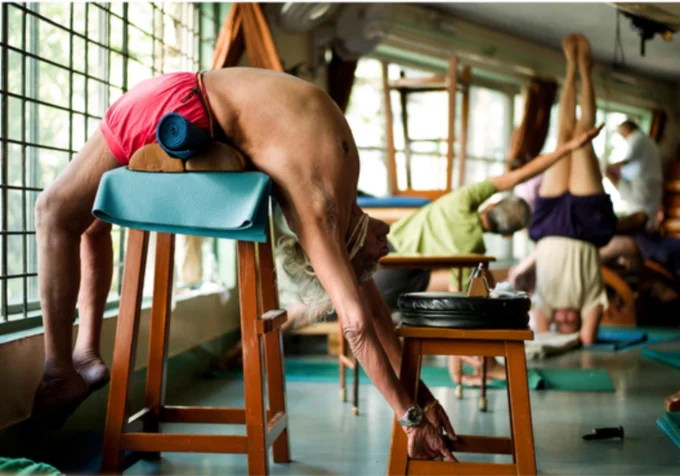
From these adaptations emerged therapeutic variations and the systematic use of props, which today represent one of the most recognizable aspects of Iyengar Yoga.
Blocks, straps, bolsters, blankets, chairs, and wall ropes are not shortcuts. They are bridges. They allow practice to:
- remain safe,
- become accessible,
- deepen without force.
Iyengar believed that yoga must not exclude. On the contrary, its task is to find a path to every body.
Precision as a path to freedom
Iyengar Yoga is often misunderstood as strict or rigid. Yet Iyengar taught that precision is not the goal, but the means. Through correct alignment, we create conditions in which the body can release, the breath deepens, and the mind becomes calm.
Freedom, in Iyengar’s view, was not spontaneous or chaotic. It was built.
Built on:
- clarity,
- repetition,
- patience,
- discipline.
When structure is stable, lightness and silence can emerge.
A teacher who never stopped being a student
One of his most profound qualities was the willingness to remain a student for life. Despite global recognition, he never spoke of having “achieved yoga.” He spoke of a process.
Even while teaching, he was learning. He observed the bodies of his students, their limitations, fears, and potential. He often emphasized that a teacher who does not observe does not teach.
He understood every body as a textbook. Every practice as an opportunity to learn.
Strict love for the practice
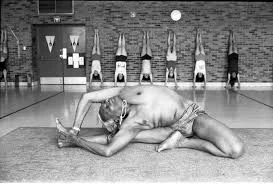
Iyengar was not a teacher who sought popularity. His strictness was not an expression of ego, but of deep respect for yoga. He rejected superficiality, spectacle, and quick results.
For him, yoga was an ethical discipline. A teacher must protect the student, not display them. Practice must strengthen, not injure. Progress without understanding had no value for him.
Asana as a gateway, not a goal
Although he is best known for his work with asanas, Iyengar never regarded them as the final goal. Asana was a tool, a means to sharpen perception and to prepare the body and mind for the deeper layers of yoga.
This is why he insisted on the basics. On standing poses. On the details of the feet, knees, pelvis, and spine. Not because they are simple, but because they are the foundation of everything else.
Yoga as part of everyday life
Iyengar did not separate yoga from life. In his view, yoga does not end when we leave the mat. It is expressed in how we stand, how we sit, how we breathe, and how we respond to stress and relationships.
Light on Yoga became a classic not because it offered perfect poses, but because it invited discipline, practice, and responsibility toward oneself.
Parampara, a living tradition
Iyengar’s legacy lives in parampara, the unbroken lineage of knowledge transmission. His work is continued today by his family in Pune and by thousands of certified teachers worldwide. Knowledge is not passed on through words alone, but through observation, direct experience, long-term practice, and teaching ethics.
Why Iyengar matters today
In a time of quick fixes, superficial trends, and constant stimulation, Iyengar Yoga offers something rare: time. Time to learn, time to make mistakes, and time to repeat. It does not promise instant change, but a gradual and lasting transformation. It teaches patience, respect for limits, and the courage to persevere, even when practice is uncomfortable.
On his birthday
On the birthday of B. K. S. Iyengar, we remember not only the man, but a way of being. Every time we place the foot precisely, lengthen the breath, or allow the support of a prop, we continue his work. This is a practice that does not seek shortcuts. It is a practice that endures. It is a practice that lives.
This understanding of practice quietly enters daily decisions, work with people, and the relationship with a changing body. Here lies his greatest legacy. Not in a system, but in an attitude. An attitude that does not require perfect conditions and does not wait for the right moment. It works even when the day is short, the body tired, and the practice reduced.
Within it, there is room for doubt, mistakes, and repetition, without a sense of failure. It is not loud or spectacular, but reliable. Over time, it shapes how we enter practice and how we return from it into the world. With the years, it becomes less important what I can do, and more important how I approach what I cannot yet do.
His teaching has shown me that perseverance does not mean force, but listening. That precision is not a limitation, but a support. And that in practice we may accept help, whether in the form of a teacher, a prop, or a simple moment of stillness.
On his birthday, I feel above all gratitude. For a path that does not promise quick answers, but teaches us to stay. On the mat, and beyond it.