

Florence, a journey through practice with Abhijata Iyengar
Friday, travel day: arrival in Florence and an evening in Carmignano
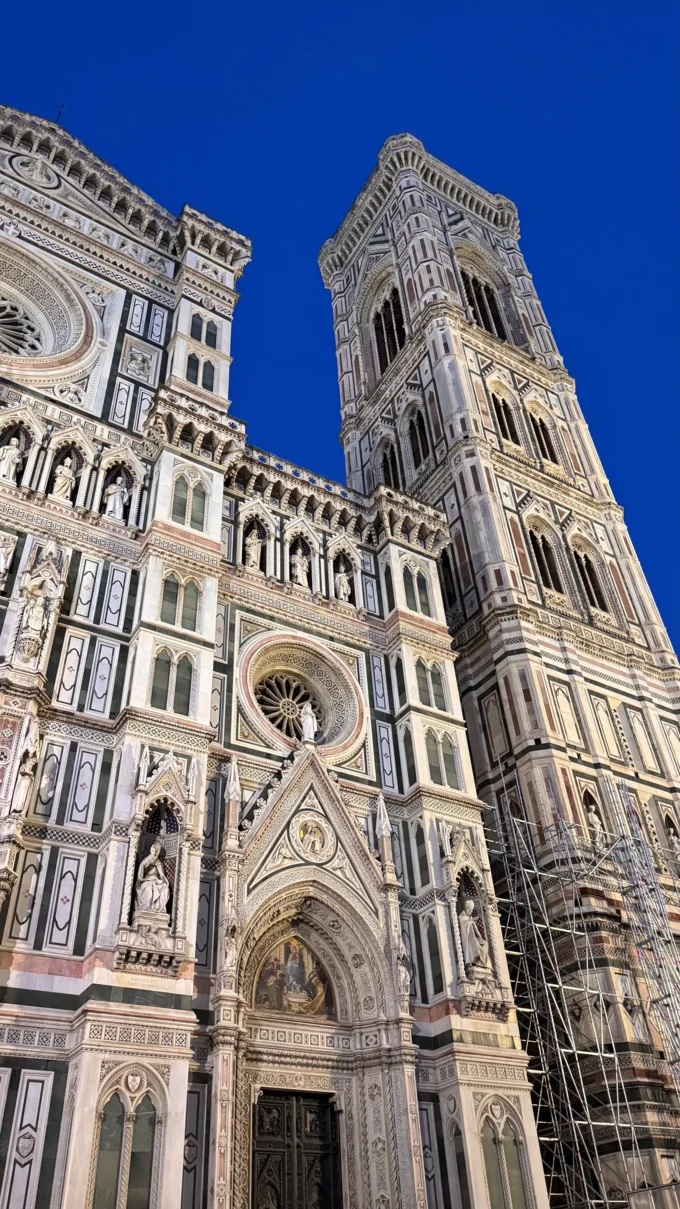
After the long journey from Kranj to Florence, the body still carried the traces of travel, hours of sitting, a certain heaviness in the hips, and a quiet dullness along the spine. The day unfolded gently, with just enough time to step into the historic center and allow Florence to meet us in its own rhythm. The quiet strength of the Duomo, the timeless presence of Ponte Vecchio, and the unmistakable figure of Michelangelo’s David left a subtle impression that lingered into the next morning. There is something in this city that brings together art and discipline, precision shaped over time, and a patience made visible.
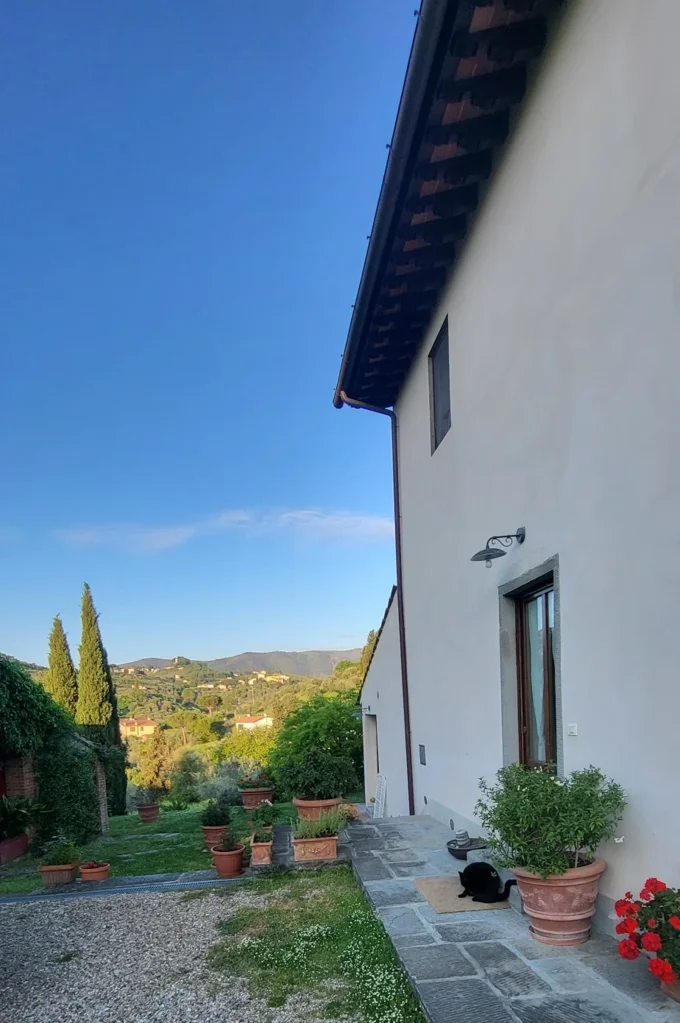
In the evening, we returned to Carmignano, in the hills just outside Florence, an area with a long winemaking tradition, once appreciated by the Medici family. Surrounded by vineyards and olive groves, we experienced a different perspective of the region, quieter, more open, and gently removed from the rhythm of the city. With soft views extending toward Florence in the distance, we allowed the impressions of the day to settle. The night was calm, and by morning, we stepped into the new day more rested, carrying both the stillness of the hills and the quiet energy of the city below.
Saturday, day one of practice
That feeling stayed with us as we stepped onto the mat, a quiet continuation of the journey, now moving from the road into the body.
Before the practice fully unfolded, we were gently reintroduced to the teacher guiding the weekend. Abhijata S. Iyengar, granddaughter of B.K.S. Iyengar, grew up within the method, learning directly from him as well as from Geeta and Prashant Iyengar. Today, she teaches at the Ramamani Iyengar Memorial Yoga Institute (RIMYI) in Pune, carrying forward a lineage that is both deeply rooted and continuously evolving.
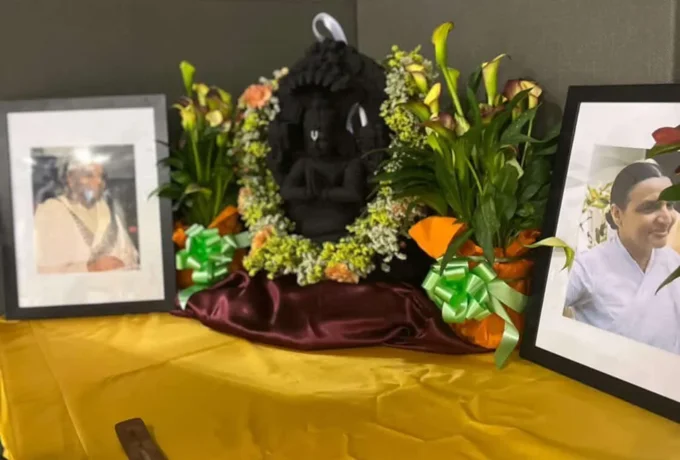
To say that she has stepped into the shoes of her grandfather is, in a way, true. The precision, the clarity, and the depth of observation are unmistakably present. And yet, what stands out more clearly now is how her teaching has matured into something distinctly her own, grounded, composed, and quietly confident.
We had experienced her teaching once before, a few years ago in Bregenz. Returning now, there was a noticeable shift. Not louder, not more complex, but more refined, more settled, and more spacious.
Saturday’s practice began with standing poses, and it felt like the most natural place to start. After the stillness of travel, the body was not yet fully present, but the sequence met it exactly where it was. There was no need for intensity, only clarity. Abhijata guided us with calm authority, allowing the work to unfold gradually rather than forcing it into shape.
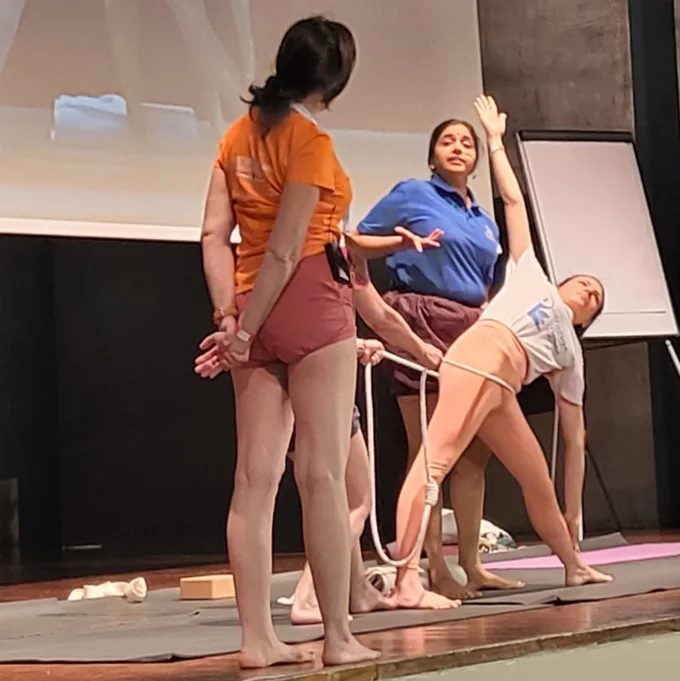
Very early on, she brought our attention to something essential. Props are not there to make things easier, but to make us more aware. A block, a belt, or even a subtle change in the position of the arms can completely transform the experience of a pose, not by supporting us passively, but by awakening intelligence in the body.
We began to explore how the placement of the arms influences the entire structure. In Urdhva Hastasana, or with the arms extended parallel to the floor, sometimes holding blocks, we were asked to stay. Not briefly, but with intention. One minute.
Long enough for the body to respond, and long enough for the mind to hesitate.
And that was where the work truly began.
The instruction was simple, yet demanding. Hold. Observe. Stay present.
Through that stillness, something became clear. As Abhijata reminded us, the beauty of yoga is that it does not separate body and mind. The body can be supported, adjusted, and guided, but the mind must learn to stay, to participate, and to support the body from within. Both have to work together. Without that connection, instructions remain theoretical. Only direct experience gives them meaning.
There was no rush to move forward. The practice asked us to remain, to sense, and to allow the action to reveal itself gradually. Stability was not imposed, it was cultivated.
As the session moved toward prāṇāyāma, the attention naturally turned inward. A belt placed around the lower ribs brought awareness to the often overlooked area of the floating ribs, opening a more subtle understanding of the breath.
The expansion was gentle and precise, never forced, never exaggerated. It was simply observed.
In that observation, the breath became a quiet teacher, guiding the mind toward a different kind of steadiness, one that does not arise from effort alone, but from sensitivity and attention.
By the end of the first day of practice, the shift was subtle, but clear. A deeper connection had begun to form, along with a more refined sense of direction and the beginning of a more attentive, conscious practice.
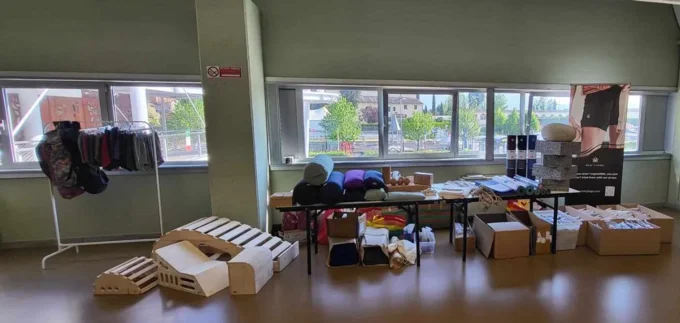
A small RunToYoga corner, built with care, ready to support practice
We arrived in Florence as RunToYoga, bringing with us a selection of carefully chosen props that support precise and attentive practice.
Setting up our stand became part of the process. Each prop placed with intention, creating a small, open space where practitioners could explore, ask questions, and connect.
It was not just about products, but about sharing the experience of practice beyond the mat.
Sunday, day two of practice, understanding the “why”
The second day began in Svastikasana, simple and steady, yet already different. The body was more present, the breath quieter, the mind less restless. Before any movement, Abhijata paused and asked:
Why do we begin like this? Why do we chant the invocation?
The question was not meant to be answered, but to open attention.
From that moment, the practice shifted. What might appear as “rules” in Iyengar Yoga revealed itself as a system of principles rooted in experience. Nothing is arbitrary. Everything has a reason, even if it is not immediately understood.
Not eating before practice allows the body to move freely.
Breathing through the nose refines and regulates the nervous system.
Śīrṣāsana awakens, Sarvāṅgāsana settles.
Śavāsana allows the effects of practice to integrate.
Seen this way, these are not rules to follow, but directions to be explored.
The invocation also took on a different meaning. Not a ritual to repeat, but a threshold, a moment of arrival, a quiet decision to be present.
With that came a simple but direct reminder: the body is constantly working for us. It takes very little for that balance to shift. Not something to fear, but something to respect and take responsibility for.
From there, the logic of the method became clearer. Nothing can be learned without experience. Words alone are not enough. If the body has not felt the action, the instruction remains abstract.
This is where props become essential, not to make things easier, but to create the conditions for understanding. They give space, support, and direction to the experience.
It also brought clarity to another question, why so many instructions?
Because clarity shapes experience, but timing is just as important. A beginner does not need everything at once. One clear action, experienced directly, is enough. From there, understanding develops gradually.
By the second day, the practice was no longer only about doing. It had become a process of seeing, questioning, and understanding. Less visible on the outside, but far more precise within.
Monday, day three of practice, teaching with clarity and care
The third day shifted the focus from personal practice to teaching. What we had been exploring in our own bodies now asked a different question, how do we share this with others, especially beginners?
Abhijata approached this with clarity and a light sense of humor, showing how easily we can discourage students without even realizing it.
Too many instructions.
Instructions the body cannot yet understand.
A voice that is flat, mechanical, without presence.
Even something as simple as repeating “extend, lift, open” without engagement can disconnect the student. Teaching is not only what we say, but how it is received.
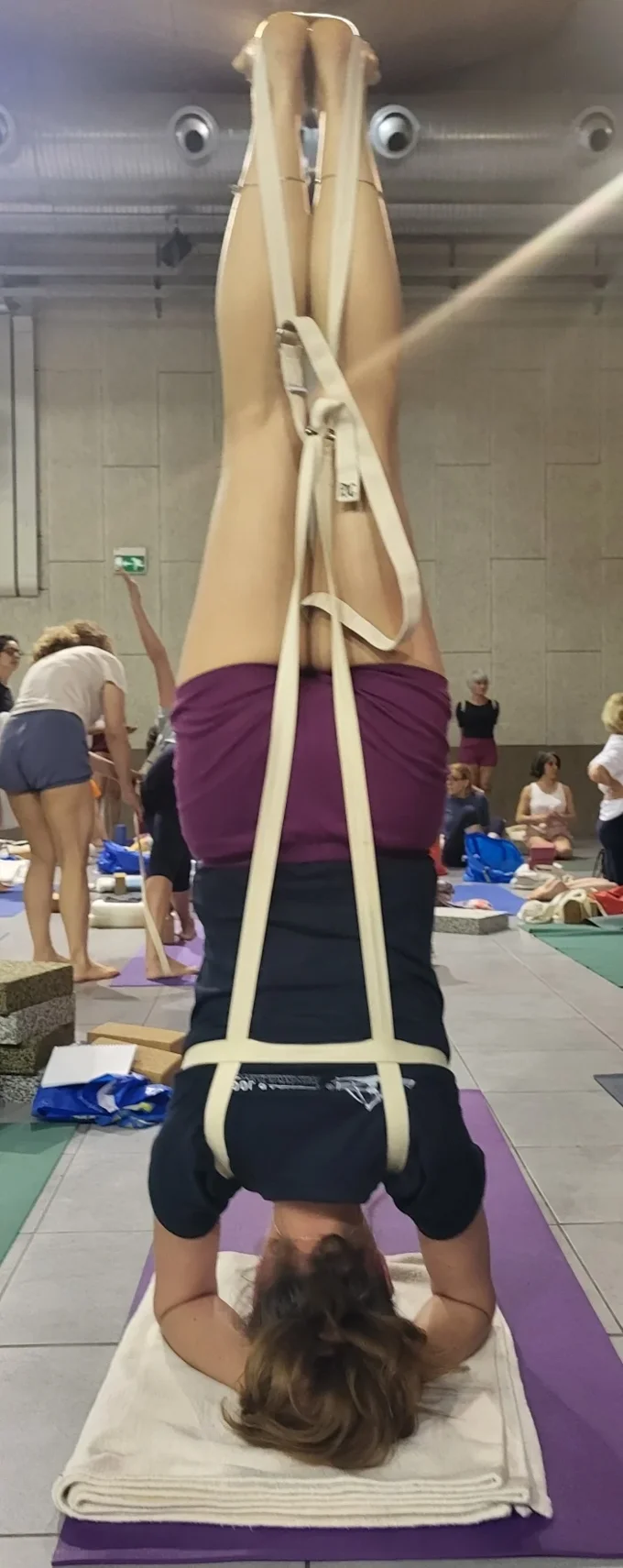
She also pointed to another common mistake, creating fear before experience. When we introduce a pose like Śīrṣāsana by explaining everything that could go wrong, the student closes before even beginning.
Her example was simple. She told her children not to step on the yellow line of an escalator. From that moment on, that became the only thing they could think about.
The same happens in teaching.
What we emphasize is what the student carries.
Beginners need clarity, encouragement, and simplicity. Not everything at once. If we imagine giving them everything that Guruji discovered over decades, it becomes obvious, it would be too much.
A beginner needs one clear instruction, something they can experience directly. From there, through repetition and their own observation, understanding begins to develop. Only then can more refined and complex actions be introduced.
Much of the day was spent working in pairs, which made this immediately real. Observing, adjusting, and communicating through touch brought teaching out of theory and into experience.
By the end of the third day, the shift was clear. Teaching is not about giving more, but about giving what is needed, at the right time, in the right way.
And that is where the depth of the method truly lives.
Conclusion
Florence became more than a destination. It was a quiet journey through history, good food, friendship, and small, unexpected moments that stayed with us longer than we anticipated. Between practice, conversations, and simple walks through the city, something continued to unfold, not only around us, but within.
In many ways, it reflected the very nature of yoga.
A path that does not end. One that is not about arriving, but about continuously exploring, refining, and experiencing. Through different shapes of the body, through attention, through presence, we begin to understand something deeper, not only on the mat, but in the way we move through life.
What we practice is never limited to the posture itself. It becomes a way of seeing, responding, and being.
And perhaps that is what we carried back with us from Florence, not just the memory of a place, but a reminder that the practice continues, quietly, in everything we do.
